Letter of Authority #
It is both accepted industry process and a contractual requirement between networks that an LOA is available on request. This in turn forms part of the commitments given to us by our Channel Partners when submitting an order (for example, when submitting an order, the Gamma Portal asks “Do you have the customer’s consent to port this number? Tick to proceed”). For expediency and efficiency, it is taken on trust throughout the value chain that the required Letter of Authority exists.
Gamma reserve the right to request a copy of the Letter of Authority as a random check and reserve the right to introduce charges in the future where problems arise in the process due to a lack of adherence to process by our Channel Partners.
You can download the LOA template from the Gamma Academy or from Help and Support then Support Documentation from the Gamma portal.
Geographic #
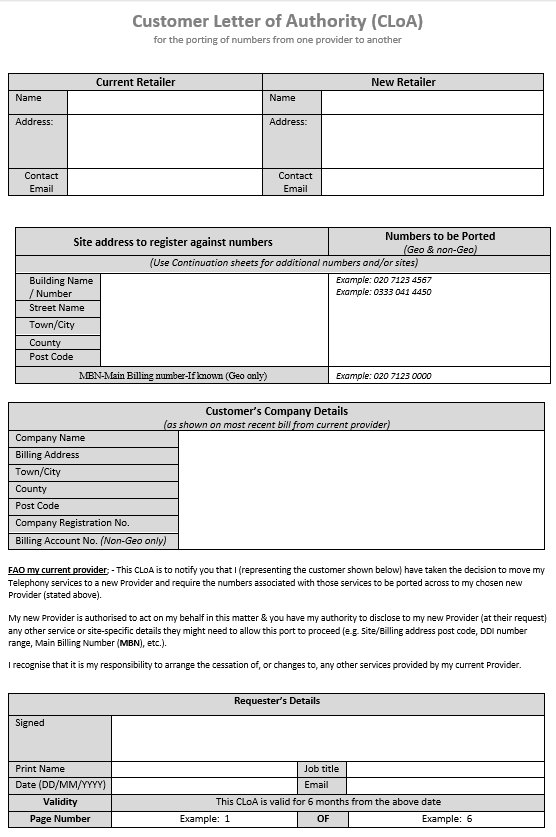
For both Geographic and non-Geographic ports LOAs will now use the same LOA template that has been introduced by the Office of the Telecoms Adjudicator & Industry. This has been introduced to help streamline the process, so you now only have one LOA to use for both port order types.
This is a legal document so must be of a high standard. This should be filled out by the end user.
Multi Line Ports #
A LOA does not need to be provided with the order but should be held by the channel partner at the point of placing the port order. If requested, you must produce this to Gamma within 24hrs. Failure to produce this quickly will result in your port order being cancelled.
Single Line Ports #
A LOA does not need to be provided with the order but should be held by the channel partner at the point of placing the port order. If requested, you must produce this to Gamma within 24hrs. Failure to produce this quickly will result in your port order being cancelled.
Non- Geographic LOA #
For both Geographic and non-Geographic ports LOAs will now use the same LOA template that has been introduced by the Office of the Telecoms Adjudicator & Industry. This has been introduced to help streamline the process, so you now only have one LOA to use for both port order types.
In the case of non-geographic ports, a LOA must accompany the order.
This is a legal document so must be of a high standard. This document should be completed by the end user.
It should be dated within the last 3 months
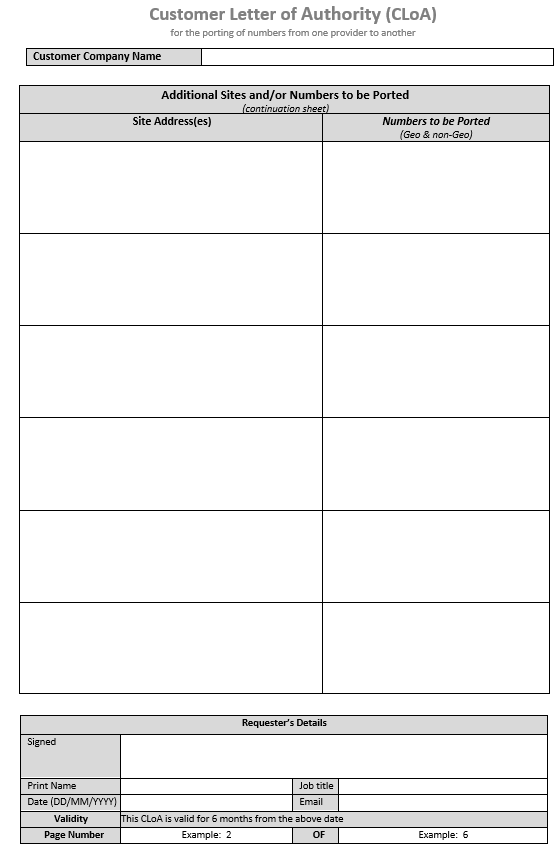
Must list ALL and ONLY numbers which are included on the port order it relates to (As on the new LOA both Geo and Non-Geo numbers can be included on the LOA as long as they all have the same current communications provider and are also for the same customer)
All pages must be signed and dated.
Preferably typed as opposed to handwritten – handwritten LOAs are often rejected by the LCP/RH.
All fields need to be filled out. If you leave a field blank because you don’t know the information, the LOA will be rejected.
Porting Definitions #
Term | Description |
BAU | Business as usual |
Communications Provider Identity Code (CUPID) | A 3 digit code assigned by Ofcom to all Network Communications Providers |
Day of Port | The date your port takes place |
DDI | Direct Dial In, can be single numbers or a range of numbers (a consecutive block of numbers) |
End User | You |
Gaining Communications Provider (GCP) | The Network you are moving your service onto |
Geographic Numbers | Numbers with a Geographic location (area code) such as 0207, 0161 etc. |
Losing Communications Provider (LCP) | The Network which is currently providing the service. Note: this isn’t necessarily the company who bills you. Resellers can also bill you. |
Letter Of Authority (LOA) | This is a legal document which states you are giving Gamma authority to act on your behalf with regards to your numbers |
Non-Geographic Numbers | Numbers with no Geographic location, such as 03, 08 and 09 |
Porting Agreement | To enable a number port there must be a commercial agreement in place between the GCP and the RH/LCP and they must have a Point of Interconnect (POI) or transit agreement with a network CP to be able to route the calls to. The CPs will also require a CUPID and a porting prefix (format 5xxxxx); these are allocated and administered by Ofcom |
Pre-Order Validation (POV) | This process can be used to find out what details the LCP hold on their systems for your numbers |
Provide Order (PRO) | This is where the LCP and RH are the same Network |
Reseller/Channel Partner (CP) | The company who you will have direct contact with regarding your numbers/service |
Range Holder (RH) | The Network which owns the number (this never changes) as originally assigned by Ofcom |
Service Level Agreement (SLA) | An agreement between all companies in the industry which outlines the reasonable expected levels of service e.g. How long a communication provider has to complete their part of a process |
Subsequent Order (SUP) | This is where the LCP and RH are different Networks |
Validation | The process used to ensure the order is correct and legitimate |
Example LOA – Geo & Non-Geographic #
 Pg1
Pg1
Order Validation #
Your order and your LOA will be validated by Gamma’s Porting Desk and all of the other Network Providers involved in the order.
During validation your order and LOA will come under scrutiny. This is for your own security. It is to stop numbers which should not be ported from being ported. This happens both by accident and fraudulently.
It’s very important that all information provided on your order is accurate. If it is not it will lead to delays – sometimes very lengthy delays.
FAQs #
Q1) When does an LOA need to be on client headed paper?
A) The LOA does not need to be on the customers letter headed paper at all anymore due to the new LOA requirements.
Q2) Do I need to type the LOA or can this be hand written?
A) Best practice here is to always type the LOA so that all details can be read. If you do need to handwrite the LOA then please use block capitals.
Q3) What is and where do we find the TO Address (current communications provider) – does this also need to be the full address? – is this the reseller or the provider who the reseller has the relationship with?
A) The address is the losing network provider’s registered company address. This can usually be found via Google search.
Q4)NGN IPEX ports – current and new operator details what format do they need to be in?
A) The operator details will be the same bar one change: current operator will be the current network operator (who if it’s a genuine NGN IPEX order will be a network Gamma do not have a porting agreement with). The Gaining Operator (Gamma) needs to be listed as per the attached.
Q5) The account number for the NGN LOA what is this?
A) The end user will have an account number with their bill provider. This is the account number that needs to be listed on the LOA, and what we also need to include on the NGN order form.
Download the Letter of Authority with the button below.